
The Factory Is Faster Series · 01
Why Does My Factory Keep Getting Faster While Sales Stay Flat? The Growth Gap Your Dashboard Can’t See
Your factory got faster but sales stayed flat? Learn why efficiency isn’t growth and take the free Manufacturing Growth Opportunity Assessment.
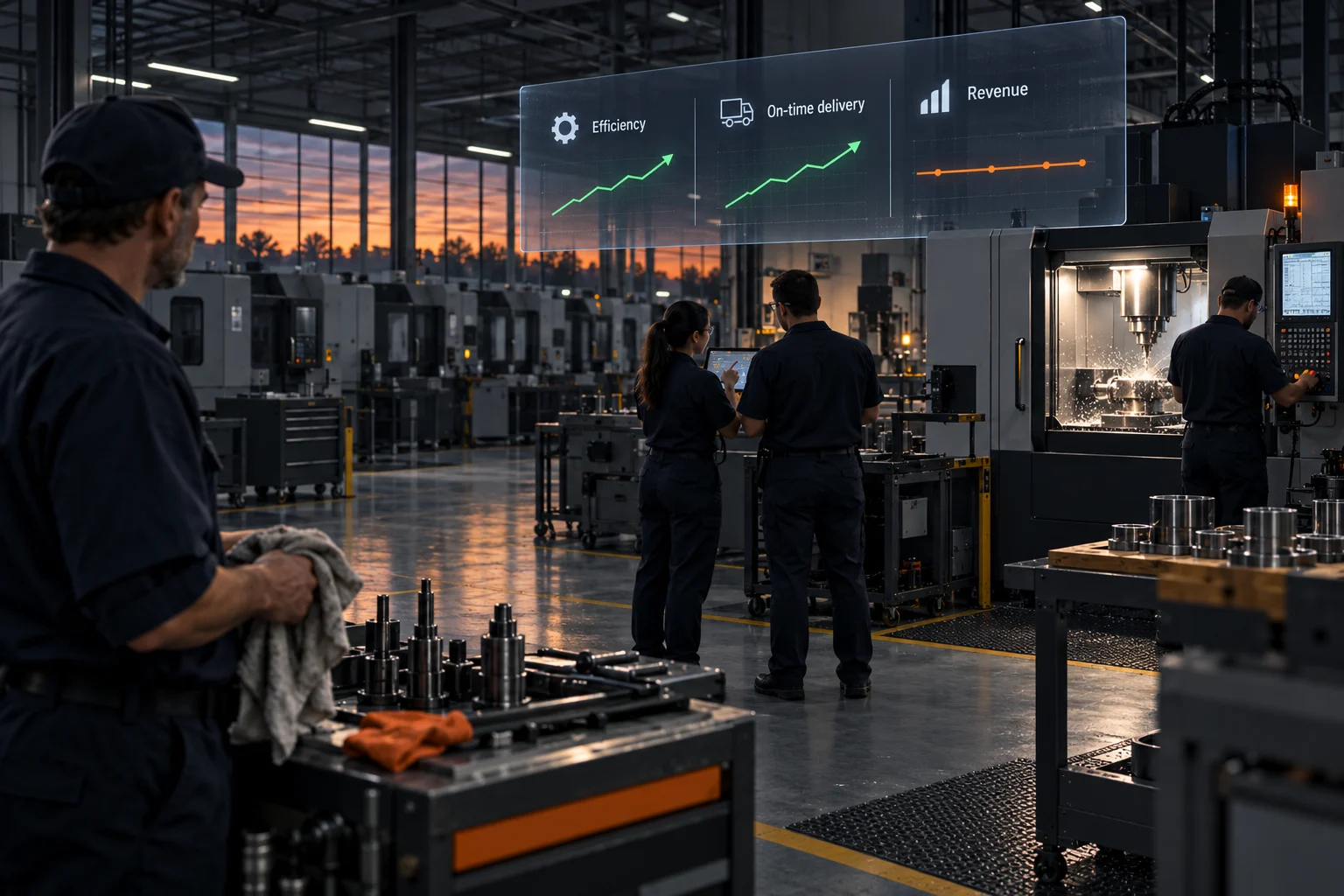
“Operational excellence is the price of admission to growth. The growth strategy itself is a separate discipline, and most manufacturers have never built it.”
— Curtiss Witt
Your factory keeps getting faster while sales stay flat because operational improvement creates capability, not demand. Lean, the Theory of Constraints, and automation make a plant better at converting the work it already has. None of them introduces you to a new buyer, tells a sourcing engineer what your shop does well, or decides which orders are worth taking. Growth requires a second system, one that finds, qualifies, and wins work that fits your plant, and most manufacturers have never built it with the rigor they gave the factory floor. The first step is finding where your business is actually constrained, then building a commercial system that answers to that constraint.
Why doesn’t a more efficient factory automatically sell more?
A more efficient factory sells more only when buyers were already waiting for the capacity. That was true when Henry Ford’s moving assembly line drove the price of a Model T within reach of millions of people who wanted one: every dollar taken out of cost came out of the price, and each price cut pulled in a new layer of buyers. Price was the barrier, and efficiency removed it.
Most contract manufacturers today sell into a different market. Your buyers already have suppliers. They have capable alternatives in every region. The barriers between you and a new customer are discovery, understanding, and trust, and efficiency does nothing to any of the three. A sourcing engineer three states away cannot see your setup reductions. A buyer evaluating alternate sources cannot read your on-time delivery chart.
The national numbers show how much room the industry has. The Federal Reserve reported U.S. manufacturing capacity utilization at 75.7% in August 2026, in its G.17 release of September 18, 2026. Treat that as a signal, not a promise: a macro index counts unstaffed shifts, idle equipment, and machines nobody would buy work for. Whether your own open hours can absorb sellable work depends on your people, programming, inspection, routings, and approvals. What the figure does confirm is that capacity, across the industry, is rarely the scarcest thing. Suitable demand is.
Where do the gains from operational improvement actually go?
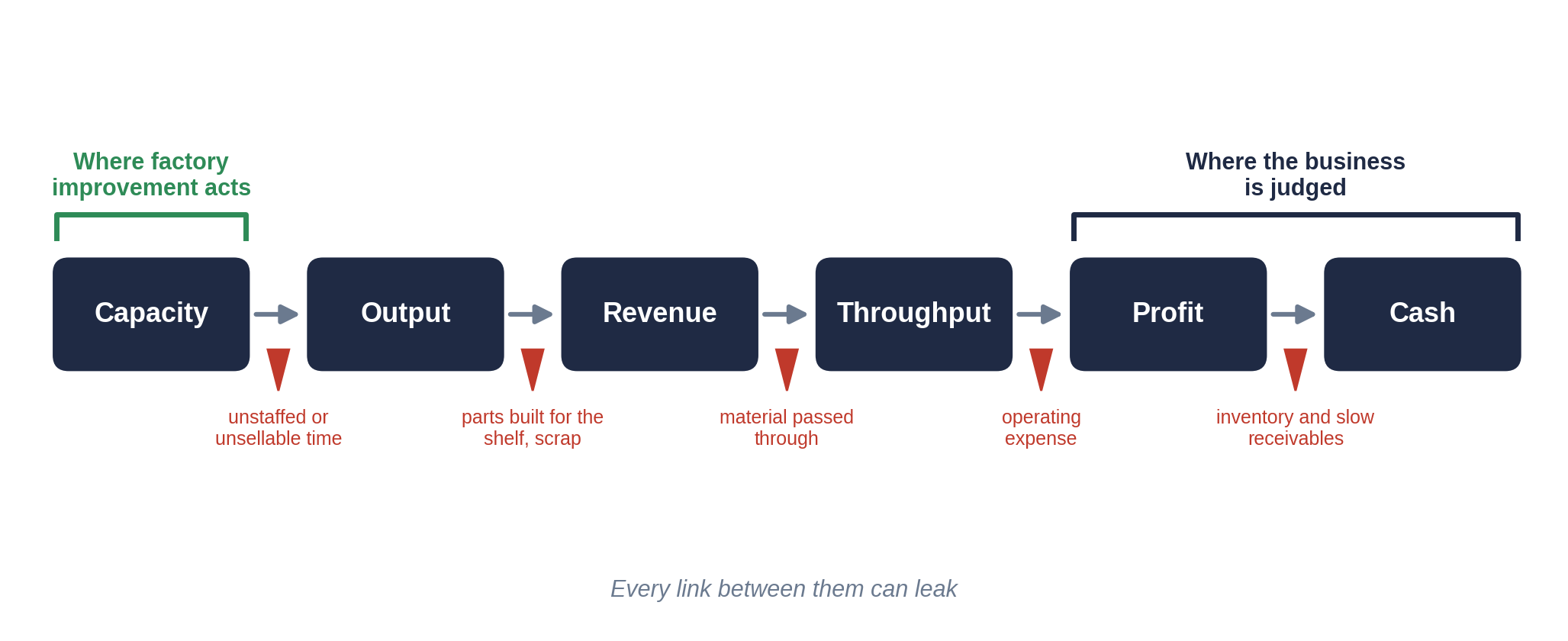
The gains stop at the top of a six-number chain unless a customer buys the additional work. Capacity becomes output, output becomes revenue, revenue becomes throughput, throughput becomes profit, and profit becomes cash. Factory improvement acts on the first link. Every link after it can leak.
I learned this the hard way. The Lean+ work I led at Boeing from 2008 to 2014 is credited with more than $500 million in cost reduction, verified by our Engineering and Product Support finance team. Most years we carried savings goals of $100 million or more, and we hit them through direct savings, cost avoidance, and labor savings. Every year we celebrated. And every year our Defense Division finance team was frustrated, because the savings never reached the division’s bottom line. The hours we freed were rarely filled with more work. Other times the money was moved to cover departments that were over budget. The savings were real, verified, and local, and the division never saw them.
That experience is why I put it plainly in The Factory Is Faster. Where Are the Customers?: “Operational excellence is the price of admission to growth. The growth strategy itself is a separate discipline, and most manufacturers have never built it.” A freed hour is worth something only when it becomes work a customer pays for.
Is the problem really sales, or is the constraint somewhere else?
A “sales problem” is really one of three different market constraints, and each one needs a different fix. The first is a demand ceiling: the total suitable demand for what you do is smaller than your capacity. The second is a discovery constraint: suitable buyers exist, but they cannot find you or cannot tell from what they find that you fit. The third is a conversion constraint: suitable buyers send work, but too little of it becomes orders because of slow quotes, poor selection, or pricing that ignores the plant.
The conversion constraint hides inside the quoting process, and the industry’s own numbers show how much is at stake. Paperless Parts, the quoting-software company, reports that job shops win about 30% of the jobs they quote, and that most shops win 20% to 30%, which means seven of every ten quotes earn nothing. Its 2020 Part Buyer Expectations Report, a survey of more than 400 U.S. part buyers, found that 67% expect a quote in less than 24 hours, up from 53% the year before. When your senior estimators are buried in requests your plant should never run, the buyers you actually want are waiting in the same queue.
The constraint can also still be inside the plant. Improvement programs often free capacity where improvement was easiest, which is not always where the bottleneck was. A scheduling policy, an approval chain, or a two-person estimating department can be the real limit. Before anyone hires another salesperson or signs a marketing retainer, someone should prove which of these is true. “Your constraint is sales” is a conclusion, and conclusions need evidence.
How are industrial buyers finding suppliers now?
Industrial buyers find new suppliers through search first and referrals a close second, and a growing share of their research now runs through AI tools. Paperless Parts’ 2022 Custom Part Buyer Report, a survey of more than 600 U.S. part buyers and engineers conducted with the research firm Researchscape, found that the top ways buyers find new vendors are internet search (64%), referrals (63%), and trade publications (31%). The same survey found that 94% of part buyers had tried at least one new vendor in the previous 12 months. Buyers are actively looking. The question is whether they can see you.
The search itself is changing. In a February 2026 survey commissioned by Xometry, the manufacturing marketplace, and fielded by John Zogby Strategies among 300 U.S. and European manufacturing leaders, 85% of aerospace and defense leaders said they are prioritizing AI-driven sourcing solutions, compared with 63% across general industry. When an engineer asks an AI assistant for a supplier who can hold a tight tolerance in titanium in small production lots, the assistant builds its answer from whatever it can find, understand, and trust. A website that lists machines and promises “quality is our top priority” gives it almost nothing to work with.
AI does not put anyone on an approved vendor list. Engineering, quality, and procurement still qualify suppliers through audits, first articles, and contracts. What AI increasingly influences is who gets considered for that qualification in the first place, and a faster factory that no one can describe accurately never gets the invitation.
What should a manufacturing leader do first?
Investigate before you spend: find out where the business is actually constrained, then point every commercial effort at that answer. The sequence below takes a few weeks of leadership attention and no new software.
- Trace your last ten late orders back to where each one lost time. A pattern points to a physical constraint; scattered lateness points to policy.
- Pull six months of requests for quotation and record each one’s source, fit, estimating hours, outcome, and the best available reason it was won or lost.
- Search for your own shop the way a buyer would. Ask several AI assistants and directories for a supplier with your exact strengths, and write down what they say about you, or whether they mention you at all.
- Organize what your leadership team knows across the five growth areas. Take the Manufacturing Growth Opportunity Assessment at AIManufacturingGrowth.com/assessment as a team: it walks through customer concentration, capacity and constraints, RFQ effectiveness, market development, and executive priorities in a few minutes, and turns your answers into the specific evidence to gather next.
- Choose one question to investigate first, and name the person who owns it. A priority without an owner is a wish.
| Traditional approach | Constraint-driven approach |
|---|---|
| Improve the plant and expect sales to follow | Improve the plant and build the commercial system to the same standard |
| Measure efficiency, utilization, and on-time delivery | Measure throughput, fit of incoming RFQs, and new-customer mix alongside delivery |
| Quote every request that arrives | Qualify requests against capability and the constraint before estimating |
| Assume the constraint has moved to sales | Prove where the constraint is, then act on it |
| Market the whole shop to everyone | Market the specific work your open capacity does well |
| Review sales and operations in separate meetings | Review both in one monthly conversation with shared measures |
What changes when the factory and the market are managed as one system?
When the factory and the market are managed as one system, the gains you already paid for finally reach the income statement. Sales sees where the constraint is and stops promising what the plant cannot deliver. Estimators spend their hours on work that fits. Your public description of the shop says what you actually do well, so the right buyers, and the AI tools working for them, can recognize you. And leadership measures the whole chain, from the buyer’s first search to the cash in the bank.
I call this approach Constraint-Driven Customer Acquisition: start with what the plant can reliably do and where it is limited, then go find the buyers whose needs make that capability valuable. The disciplines that made your factory faster already contain everything your commercial system is missing. Most manufacturers just never carried them across the wall.
Your next step
Every quarter you run a faster factory without a commercial system built to match it, the capacity you paid for earns nothing, and the gap gets harder to see because the operations dashboard keeps looking good. In a few minutes, the Manufacturing Growth Opportunity Assessment shows which of the five growth areas your leadership team can answer with evidence today, and which it can’t yet. Start at AIManufacturingGrowth.com/assessment.
Disclaimer
The Manufacturing Growth Opportunity Assessment is an educational investigation guide. It organizes what you report about your business into areas to review and information to gather. It does not diagnose your business, identify your system constraint, value any opportunity, or forecast results, and it is not legal, financial, or compliance advice.
FAQ
Why does my factory keep getting faster while sales stay flat?
Because operational improvement creates capability, not demand. Lean, Theory of Constraints, and automation help the plant convert work it already has; they do not help a buyer discover you, understand what you do well, or choose you. Growth needs a commercial system built with the same rigor as the factory.
Isn’t an online growth assessment just a lead form in disguise?
Not this one. The Manufacturing Growth Opportunity Assessment at AIManufacturingGrowth.com/assessment asks for no email, account, or financial figures, and shows its findings on screen the moment you finish. Talking to anyone about the results is a separate choice you make, or don’t.
Does the Federal Reserve’s capacity utilization figure mean my shop has room for more work?
No. The 75.7% manufacturing utilization the Federal Reserve reported for August 2026 is a national index. Your own usable capacity depends on staffing, programming, inspection, routings, and approvals in your plant.
What is a normal RFQ win rate for a job shop?
Paperless Parts reports that job shops win about 30% of the jobs they quote, with most between 20% and 30%. Your own history, broken down by type of work and buyer, matters more than any industry average.
Will AI assistants recommend my shop to buyers?
No one can guarantee that. Clear, accurate, consistent information about what you do well improves the odds that AI tools describe you correctly, and AI never replaces a buyer’s own supplier qualification.
Can the assessment tell me where my constraint is?
No. It organizes what your leadership team reports into areas to review and evidence to gather. Finding the constraint takes an investigation of your own routings, queues, and order history.
How long until better commercial discipline shows up in sales?
Industrial sales cycles run in quarters and years. Within 90 days you can change how growth decisions are made and test one focused hypothesis; orders from new customers usually take longer.
References
Federal Reserve Board. (2026, September 18). G.17 Industrial Production and Capacity Utilization, Table 12: Manufacturing. https://www.federalreserve.gov/releases/g17/20260918/table12.htm
Paperless Parts. The 7 Fatal Mistakes of Quoting, #1: Treating Every Quote the Same. https://www.paperlessparts.com/blog/the-7-fatal-mistakes-of-quoting-1-treating-every-quote-the-same/
Paperless Parts. Costing Is a Science, Pricing Is an Art: The Over-Engineered Quote (webinar). https://paperlessparts.com/resources/webinar-costing-is-a-science-pricing-is-an-art-the-over-engineered-quote
Paperless Parts. (2020). 2020 Part Buyer Expectations Report. https://www.paperlessparts.com/wp-content/uploads/paperless-parts-buyer-survey-report-2020.pdf
Paperless Parts. (2022, December 19). Industrial Buyer Survey Reveals New Implications for U.S. Manufacturers Throughout the Supply Chain. https://www.paperlessparts.com/press/industrial-buyer-survey-reveals-new-implications-for-us-manufacturers-throughout-the-supply-chain/
Xometry. (2026, February 3). Aerospace & Defense Leaders Prioritize AI-Enabled Sourcing to Strengthen Domestic Supply Chains. https://investors.xometry.com/news-releases/news-release-details/aerospace-defense-leaders-prioritize-ai-enabled-sourcing
Witt, C. (2026). The Factory Is Faster. Where Are the Customers?
← All Manufacturing Growth Insights