
The Factory Is Faster Series · 02
What Is Constraint-Driven Customer Acquisition? The Framework for Winning the Work Your Factory Should Run
Constraint-Driven Customer Acquisition connects your factory’s constraint to the buyers who fit it. Learn the five steps and take the free growth assessment.
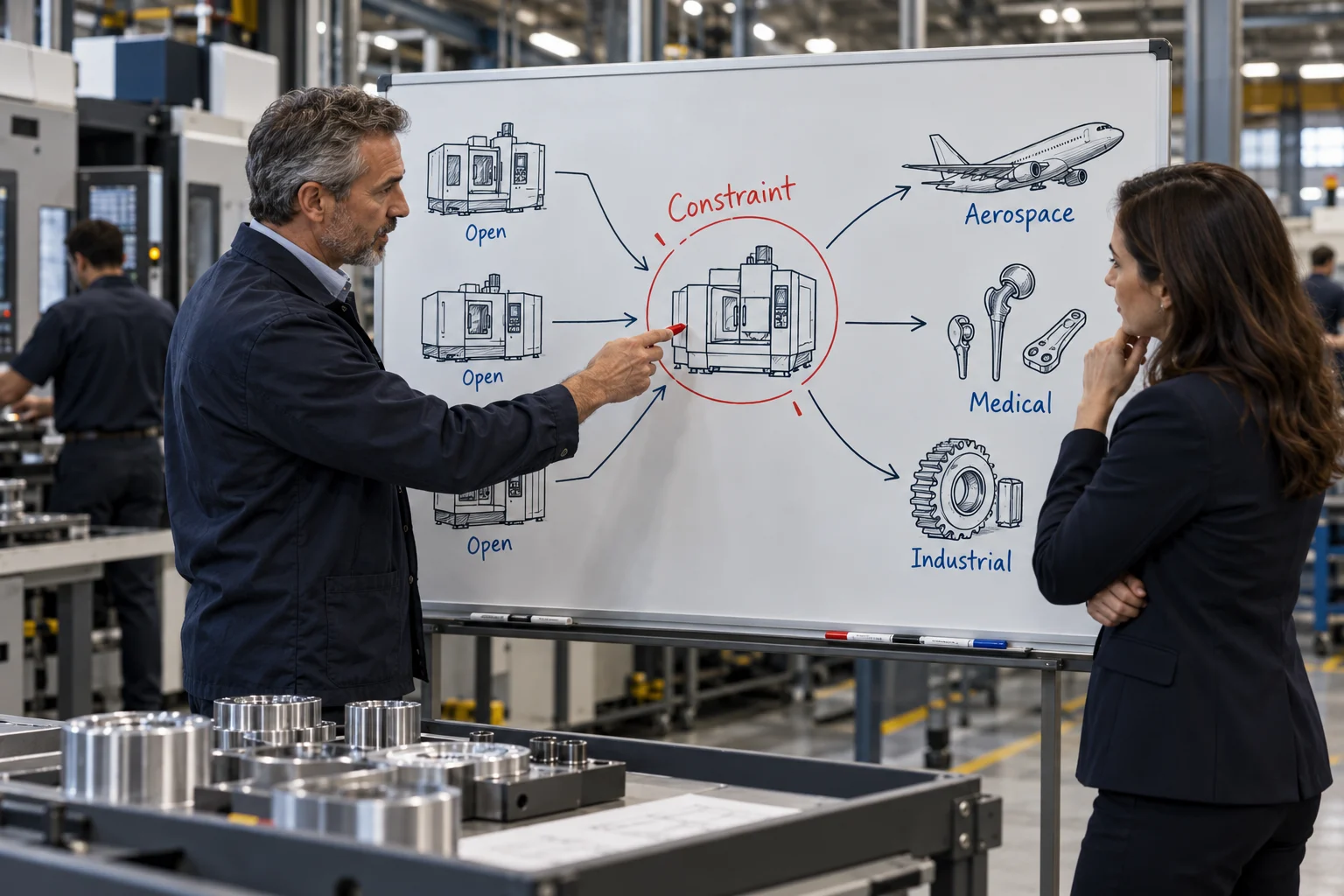
“Marketing that ignores the constraint is a well-funded way to overload the wrong machine.”
— Curtiss Witt
Constraint-Driven Customer Acquisition, or CDCA, is an operating framework that connects what your factory can reliably deliver, and where it is actually limited, with the buyers and markets whose needs make that capability valuable. It reverses the usual order of growth. Conventional demand generation goes looking for leads and lets the plant sort them out. CDCA starts inside the plant, establishes what kind of work makes the whole business stronger, and only then goes looking for the buyers who send that work. The constraint drives the customer strategy, not the other way around.
Why do manufacturers need a different approach to customer acquisition?
Manufacturers need a different approach because most growth methods treat factory capacity as unlimited and interchangeable, and a factory is neither. Every order flows through specific machines, people, inspection steps, and outside processes. An order that loads your busiest resource can push every job behind it late. An order that runs on open resources can be nearly pure profit, even at a price a standard-cost report calls thin.
Generic lead generation can’t see any of that. It fills the pipeline, the estimating team quotes whatever arrives, and the plant absorbs the consequences. The cost shows up in the quoting numbers first. Paperless Parts, the quoting-software company, reports that job shops win about 30% of the jobs they quote, and that most win 20% to 30%. That means seven of every ten quotes, built by your most experienced people, earn nothing. More leads poured into that funnel produce more waste, not more growth.
As I wrote in The Factory Is Faster. Where Are the Customers?, “Marketing that ignores the constraint is a well-funded way to overload the wrong machine.” The answer isn’t less marketing. It’s marketing that knows which machine the work will run on.
What are the five activities of Constraint-Driven Customer Acquisition?
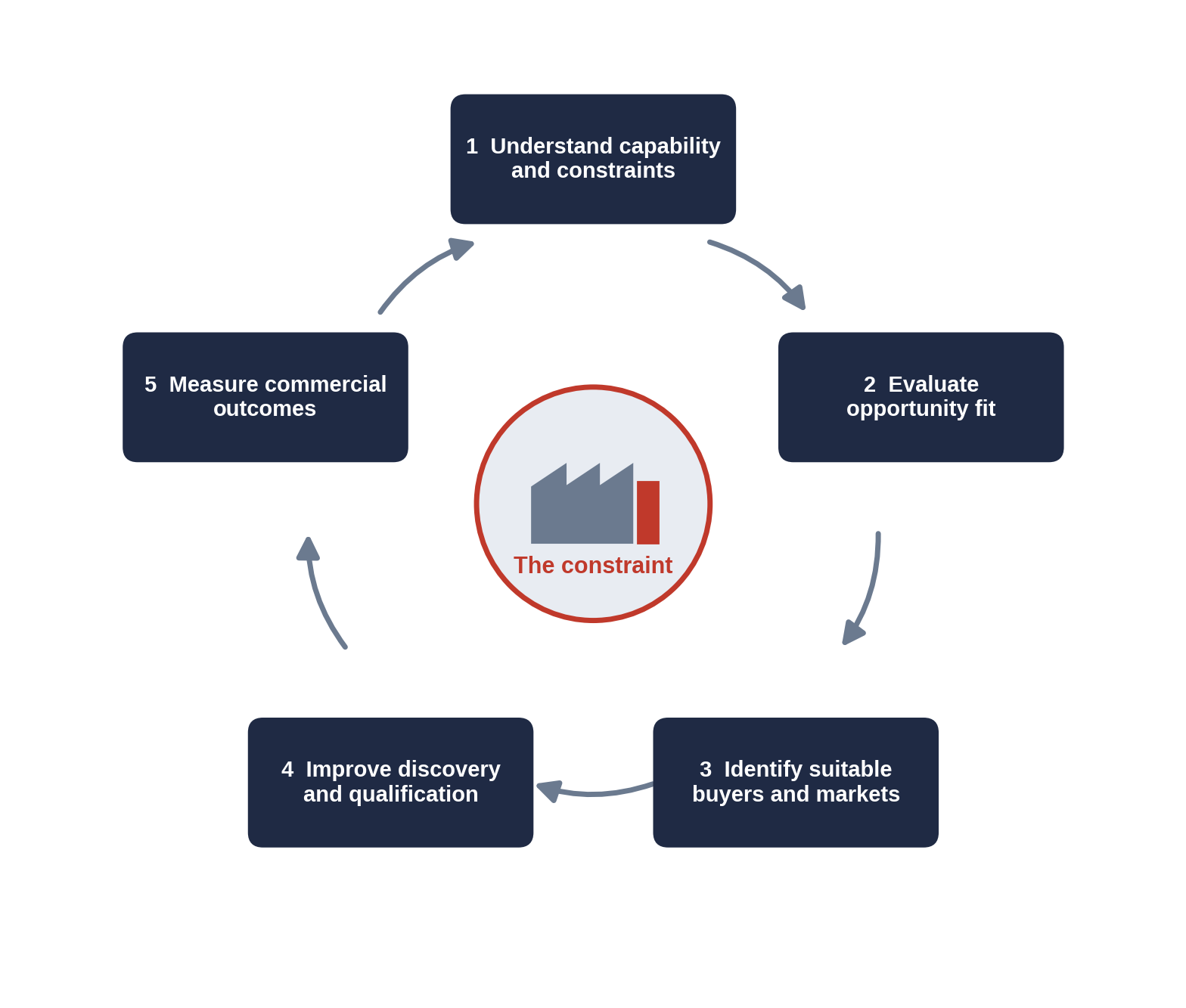
CDCA runs as a continuous loop of five activities, each owned by the people who hold the facts it needs.
- Understand capability and constraints. Operations and quality establish what the plant demonstrably does well, where the constraint is today, and which resources have genuinely usable room once people, programming, and inspection are counted. The output is a short capability and constraint brief that a salesperson can read.
- Evaluate opportunity fit. Sales, estimating, operations, and finance agree on what a good-fit order looks like across engineering, manufacturing, delivery, and economics, and write it down. The rule is simple: evaluate fit before generating demand, not after it arrives.
- Identify suitable buyers and markets. Leadership translates the fit profile into the industries, applications, and buyer types that send that work, and treats each target market as a hypothesis to test.
- Improve discovery and qualification. Marketing makes the company’s real capabilities findable and understandable to those buyers, and the qualification process screens what arrives so senior estimating time goes where it belongs.
- Measure commercial outcomes. Leadership tracks suitable inquiries, fitting requests for quotation, wins, and what new work does to throughput and delivery, then feeds the evidence back into the first activity.
How is CDCA different from traditional manufacturing lead generation?
CDCA differs from traditional lead generation in where it starts, what it measures, and who owns it. Lead generation starts with the market and measures volume. CDCA starts with the plant and measures fit and throughput. The framework is new. Its parts have earned their place over decades: Lean’s insistence that value is defined by the customer, the Theory of Constraints’ focus on the limiting resource, throughput accounting, and the measurement culture of Six Sigma, carried across the wall into the commercial side of the business.
| Traditional lead generation | Constraint-Driven Customer Acquisition |
|---|---|
| Starts with the market and asks for more leads | Starts with the plant and asks what work fits |
| Treats capacity as unlimited | Protects the constraint and markets open capacity |
| Measures traffic, leads, and quote volume | Measures fitting RFQs, wins, and throughput of new work |
| Quotes whatever arrives | Qualifies requests before estimating effort is spent |
| Owned by marketing or an outside agency | Owned jointly by sales, operations, and leadership |
| Runs as a campaign | Runs as a continuous learning loop |
The measurement difference matters most. Website traffic is not demand. A rising number of inquiries is not a rising number of suitable inquiries. CDCA judges every commercial effort by the rungs closest to the business: fitting work won, and what that work did to the plant.
Where does artificial intelligence fit in CDCA?
Artificial intelligence fits in two places: helping suitable buyers find and understand you, and helping your team prepare better qualification decisions. On the buyer side, industrial discovery is already shifting. Paperless Parts’ 2022 Custom Part Buyer Report, a survey of more than 600 U.S. part buyers and engineers, found that internet search (64%) and referrals (63%) are the top ways buyers find new vendors. In a February 2026 survey commissioned by Xometry, the manufacturing marketplace, 85% of aerospace and defense leaders said they are prioritizing AI-driven sourcing solutions. AI tools build their answers from information they can find, read, and trust, which is why CDCA puts verified, specific capability information at the heart of discovery.
Inside the business, AI can organize incoming requests, compare their requirements with your documented capability, flag missing information, and assemble the facts a qualification conversation needs. AI prepares the decision. Accountable people make it. Fit criteria guide decisions. They never make them automatically.
How does a leadership team start using CDCA?
A leadership team starts by establishing the facts the whole loop depends on, beginning with where the business is actually constrained.
- Write a first capability and constraint brief. Two or three pages: what you do especially well, where the constraint is today and how you know, where you have usable room and for what kind of work, and what you must protect for existing customers.
- Write down what a good-fit order looks like. Even a rough version gives sales and estimating a shared standard to apply.
- Find out where your business stands across the five growth areas. Take the Manufacturing Growth Opportunity Assessment at AIManufacturingGrowth.com/assessment. It organizes what your leadership team knows about customer concentration, capacity and constraints, RFQ effectiveness, market development, and executive priorities, and turns it into the evidence to gather next.
- Pick one target market as a hypothesis, and define how you’ll know within a set period whether it sends work that fits.
The point of CDCA is not a new department or a new software system. It’s a new standard: every commercial decision answers to the constraint, the same way every production decision already does.
Your next step
Every month your commercial effort runs without knowing which machine the work will land on, you risk paying twice: once to win the wrong order, and again when it clogs the resource your best customers depend on. The Manufacturing Growth Opportunity Assessment shows, in a few minutes, which parts of the CDCA loop your leadership team can already answer with evidence. Start at AIManufacturingGrowth.com/assessment.
Disclaimer
The Manufacturing Growth Opportunity Assessment is an educational investigation guide. It organizes what you report about your business into areas to review and information to gather. It does not diagnose your business, identify your system constraint, value any opportunity, or forecast results, and it is not legal, financial, or compliance advice.
FAQ
What is Constraint-Driven Customer Acquisition?
An operating framework that connects a manufacturer’s verified capabilities and actual constraint with the buyers whose needs make that capability valuable, through five continuous activities: understand capability and constraints, evaluate fit, identify suitable buyers, improve discovery and qualification, and measure outcomes.
How is CDCA different from hiring a marketing agency?
An agency generates demand. CDCA decides which demand is worth generating, based on what your plant can absorb and where it is limited. A good agency can execute inside a CDCA plan, but it shouldn’t be the one setting it.
Do I need special software to use CDCA?
No. The first activities run on a short written brief, written fit criteria, and a quote log your team keeps. Software and AI help later, once the standards exist.
Isn’t the assessment just a way to collect my contact information?
No. The Manufacturing Growth Opportunity Assessment at AIManufacturingGrowth.com/assessment asks for no email, account, or financial figures, and shows its findings on screen when you finish. Talking to anyone about the results is a separate choice.
Does CDCA guarantee more sales?
No framework can. CDCA improves the odds by making sure commercial effort goes toward work your plant can deliver profitably, and by measuring what actually happens so the business learns.
Where should a small job shop start?
With the constraint. Trace recent late orders to where they lost time, and write down what kind of work runs cleanly through your open resources. That description is the start of your buyer profile.
References
Paperless Parts. The 7 Fatal Mistakes of Quoting, #1: Treating Every Quote the Same. https://www.paperlessparts.com/blog/the-7-fatal-mistakes-of-quoting-1-treating-every-quote-the-same/
Paperless Parts. Costing Is a Science, Pricing Is an Art: The Over-Engineered Quote (webinar). https://paperlessparts.com/resources/webinar-costing-is-a-science-pricing-is-an-art-the-over-engineered-quote
Paperless Parts. (2022, December 19). Industrial Buyer Survey Reveals New Implications for U.S. Manufacturers Throughout the Supply Chain. https://www.paperlessparts.com/press/industrial-buyer-survey-reveals-new-implications-for-us-manufacturers-throughout-the-supply-chain/
Xometry. (2026, February 3). Aerospace & Defense Leaders Prioritize AI-Enabled Sourcing to Strengthen Domestic Supply Chains. https://investors.xometry.com/news-releases/news-release-details/aerospace-defense-leaders-prioritize-ai-enabled-sourcing
Goldratt, E. M., & Cox, J. (1984). The Goal: A Process of Ongoing Improvement. North River Press.
Witt, C. (2026). The Factory Is Faster. Where Are the Customers?
← All Manufacturing Growth Insights