
The Factory Is Faster Series · 07
What Should a Manufacturing CEO Investigate First to Grow? Five Questions, and Why the First Choice Is Yours
Five growth questions every manufacturing CEO must answer, and how to pick the first one. Take the free Manufacturing Growth Opportunity Assessment.

“Choosing what to investigate first is a leadership decision that balances urgency, opportunity, available attention, and strategy.”
— Curtiss Witt
A manufacturing CEO should start by asking five questions: how dependent the business is on a few customers, whether leadership shares a reliable picture of where more work could fit, whether the RFQ process brings in and learns from the right opportunities, how the company develops suitable new buyers, and which of these the leadership team will investigate first and who owns it. Which one to start with is a judgment call, not a formula. It depends on what is most urgent, what is most promising, and how much leadership attention is really available. What doesn’t work is trying to fix all five at once, or fixing none of them because no one owns the next step.
What are the five questions every manufacturing CEO must answer?
The five questions cover where your business comes from, what your plant can absorb, how opportunities enter, how new buyers find you, and how leadership decides. Each one has a number worth knowing.
- Customer concentration. How dependent is the business on a few major customers, and what deserves examination about that dependence? Buyers of businesses watch it closely: M&A advisory firm CT Acquisitions says a top customer at 25% to 40% of revenue can cost 0.5 to 1.5 turns of EBITDA in a sale, and 50% or more can cost 1.5 to 3 turns.
- Capacity and constraints. Does leadership share a reliable picture of where additional work could fit? The Federal Reserve put U.S. manufacturing capacity utilization at 75.7% in August 2026, but a national figure says nothing about which of your resources is truly open.
- RFQ effectiveness. Is your quoting process bringing in, selecting, and learning from the right opportunities? Paperless Parts reports that job shops win about 30% of what they quote.
- Market development. How do suitable new buyers find you, and can they understand what you do well? In Paperless Parts’ 2022 survey of more than 600 part buyers and engineers, 64% found new vendors through internet search and 63% through referrals.
- Executive growth priorities. Which question will leadership investigate first, and who owns the next step, by when?
How do the five questions connect?
The five questions form one investigation into one business, and their power comes from how they connect. Customer concentration shapes which new buyers you need and how quickly. Capacity and constraints decide what kind of work any commercial effort should pursue. RFQ effectiveness shows whether the opportunities arriving are suitable, which is direct evidence about market development. Market development decides what arrives in the RFQ process in the first place. And executive priorities set the order and the owner for everything else.
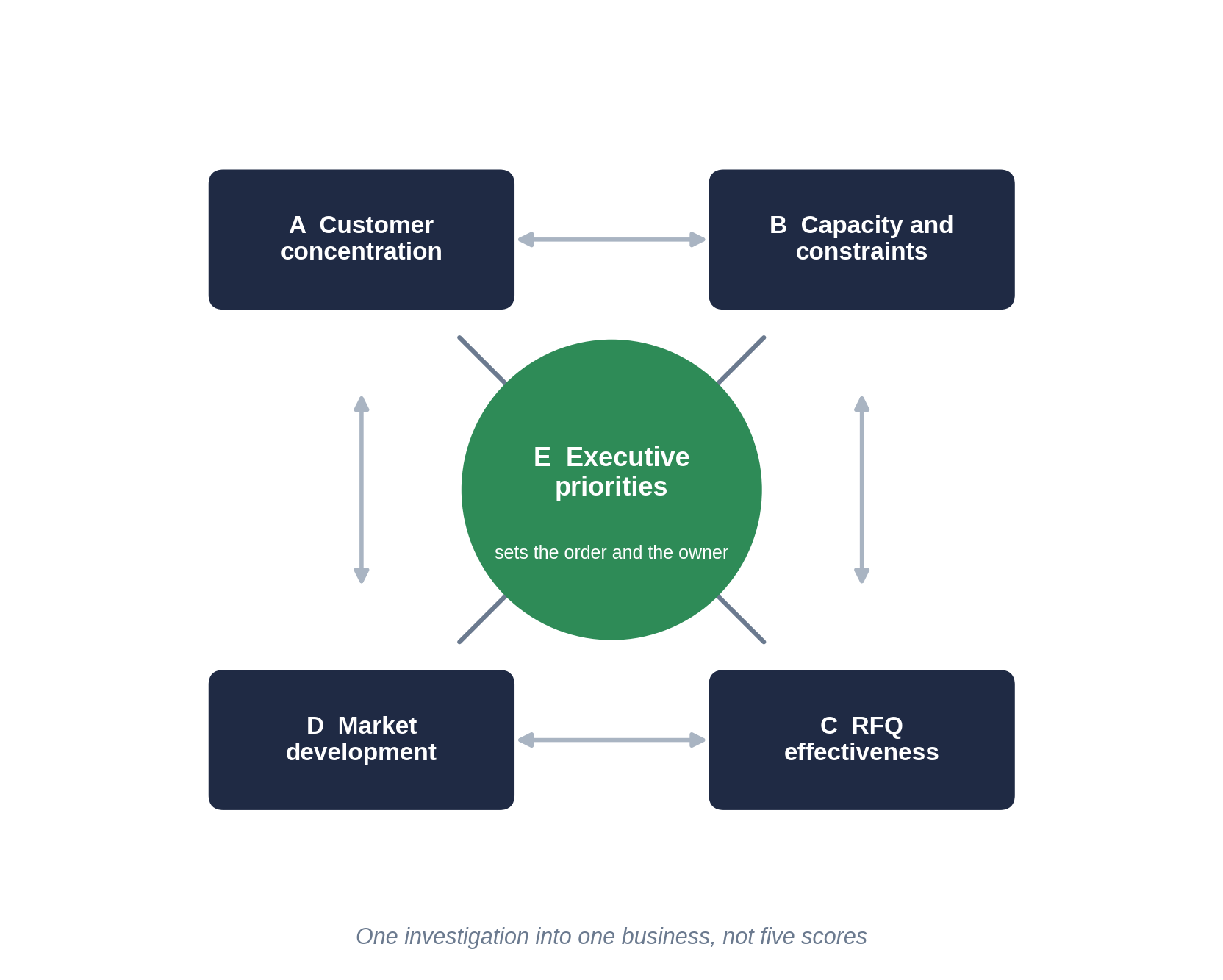
That’s why adding the five questions up into a risk score would destroy what makes them useful. A concentrated customer base can be perfectly durable. A messy-looking RFQ process can be deliberately exploratory. Only the connections, read by people who know the business, reveal what deserves action.
How do you decide which question to investigate first?
You decide by matching the question to the most pressing signal in your own business. As I wrote in The Factory Is Faster. Where Are the Customers?: “Choosing what to investigate first is a leadership decision that balances urgency, opportunity, available attention, and strategy.” Some signals point clearly:
- Your anchor customer is showing warning signs (a new buyer, softening forecasts, cost-breakdown requests): start with customer concentration.
- Delivery has been slipping for months: start with capacity and constraints, because any new commercial effort will make it worse.
- Your estimators are buried and win little: start with RFQ effectiveness.
- The plant has room, but few fitting inquiries arrive: start with market development.
- Every leader names a different problem and nothing gets assigned: start with executive priorities, and make the choice explicit.
Whatever you choose, choose one. A leadership team that names five first priorities has named none.
| Everything is a priority | One question first |
|---|---|
| Five initiatives launched at once | One question investigated deliberately |
| “The leadership team” owns growth | A named owner with a date |
| Progress reported as activity | Progress reported as evidence gathered |
| Priorities restated every quarter | Priorities reviewed monthly and changed on evidence |
| Concerns debated from memory | Concerns tested against account history, queues, and quote logs |
Who should own the investigation?
One named person should own each investigation, with the standing to convene sales, operations, quality, and finance, and the time to do the work. “The leadership team” is not an owner. Neither is a committee. Someone is accountable for bringing evidence and a recommended next step back to leadership by a stated date.
The owner’s progress belongs on the monthly leadership agenda. A priority that does not appear on that agenda month after month has been abandoned, whatever the planning documents say.
A practical way to start: have each member of your leadership team take the Manufacturing Growth Opportunity Assessment at AIManufacturingGrowth.com/assessment on their own, then compare the results. The assessment organizes each leader’s answers across all five questions, records what’s unknown, and names the evidence to gather. Where your leaders’ answers disagree is usually the most useful finding of all.
Your next step
Every month the five questions stay unassigned, the decisions they would inform keep getting made by default: the next quote, the next hire, the next marketing spend. Give your leadership team a shared starting point in a few minutes, and pick your first question with evidence in front of you. Start at AIManufacturingGrowth.com/assessment.
Disclaimer
The Manufacturing Growth Opportunity Assessment is an educational investigation guide. It organizes what you report about your business into areas to review and information to gather. It does not diagnose your business, identify your system constraint, value any opportunity, or forecast results, and it is not legal, financial, or compliance advice.
FAQ
What should a manufacturing CEO investigate first to grow?
Whichever of the five growth questions your business’s most pressing signal points to: customer concentration, capacity and constraints, RFQ effectiveness, market development, or executive priorities. The choice is a leadership judgment, made explicitly, with a named owner.
Why not work on all five at once?
Because leadership attention is limited, and a team that names five first priorities has named none. Investigate one deliberately, then move to the next.
Can the five answers be combined into one growth score?
They shouldn’t be. Each question means something different, and their value comes from how they connect, not from a total.
Who should own the investigation?
One named person with the standing to convene the functions involved, a date to report back, and a place on the monthly leadership agenda.
How can the leadership team see where it disagrees?
Have each leader take the Manufacturing Growth Opportunity Assessment at AIManufacturingGrowth.com/assessment separately, then compare. It asks for no email, account, or financial figures.
Does the assessment rank which question matters most?
No. It reports each area separately, with no weights, total score, or “top opportunity” label. Choosing the first question stays with leadership.
References
CT Acquisitions. (2026). What Is My Manufacturing Business Worth? https://ctacquisitions.com/?p=10491
Federal Reserve Board. (2026, September 18). G.17 Industrial Production and Capacity Utilization, Table 12: Manufacturing. https://www.federalreserve.gov/releases/g17/20260918/table12.htm
Paperless Parts. The 7 Fatal Mistakes of Quoting, #1: Treating Every Quote the Same. https://www.paperlessparts.com/blog/the-7-fatal-mistakes-of-quoting-1-treating-every-quote-the-same/
Paperless Parts. (2022, December 19). Industrial Buyer Survey Reveals New Implications for U.S. Manufacturers Throughout the Supply Chain. https://www.paperlessparts.com/press/industrial-buyer-survey-reveals-new-implications-for-us-manufacturers-throughout-the-supply-chain/
Witt, C. (2026). The Factory Is Faster. Where Are the Customers?
← All Manufacturing Growth Insights