The Factory Is Faster Series · 05
How Do Industrial Buyers Find New Suppliers Today? Why Being Found Is Only the First Gate
Industrial buyers find suppliers through search, referrals, and now AI. See the survey data and take the free Manufacturing Growth Opportunity Assessment.
“An equipment list is a claim. A part history is evidence.”
— Curtiss Witt
Industrial buyers find new suppliers mainly through internet search and referrals, and a growing share of their early research now runs through AI tools. Paperless Parts’ 2022 Custom Part Buyer Report, a survey of more than 600 U.S. part buyers and engineers, ranked internet search (64%), referrals (63%), and trade publications (31%) as the top ways buyers find new vendors, and found that 94% had tried at least one new vendor in the previous year. Buyers are actively looking. But being found is only the first gate. Buyers have to understand what you do, consider you, and qualify you before an order ever arrives.
Where do part buyers look first when they need a new supplier?
Part buyers look first to internet search and to people they trust. In Paperless Parts’ 2022 survey, conducted with the research firm Researchscape, search and referrals ran nearly even at 64% and 63%, with trade publications a distant third at 31%. Two years earlier, Paperless Parts’ 2020 Part Buyer Expectations Report found that 70% of buyers had used a Google or internet search to find new suppliers in the prior year, with referrals the second most common source at 46%. The company reported that buyers’ reliance on referrals jumped 17% between the two surveys, which it read as buyers wanting vetted, recommended suppliers in uncertain times.
The lesson for a manufacturer is that both channels matter, and both depend on the same thing: someone, or something, being able to describe what your shop does well. A referral is a person vouching for you. A search result is your own description doing the vouching. When your description is an equipment list and a slogan, neither channel has much to work with.
How is AI changing the way buyers discover suppliers?
AI is changing supplier discovery by doing the early research that buyers used to do by hand: gathering options, comparing them, and building a short list. In a February 2026 survey commissioned by Xometry, the manufacturing marketplace, and fielded by John Zogby Strategies among 300 U.S. and European manufacturing leaders, 85% of aerospace and defense leaders said they are prioritizing AI-driven sourcing solutions, compared with 63% across general industry.
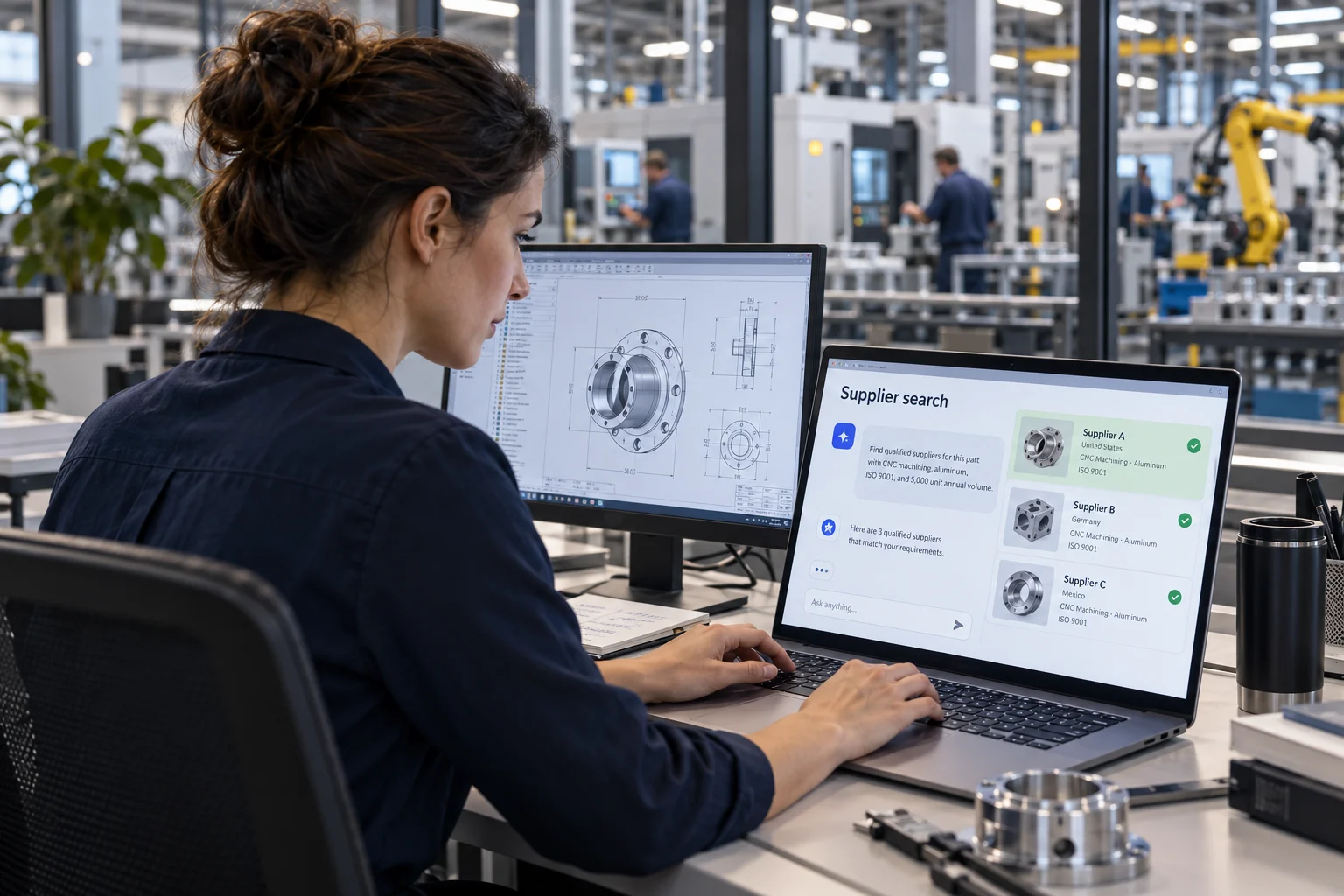
When an engineer describes a part to an AI assistant (material, tolerance, quantity, certification, region, timeline), the assistant builds its answer from whatever it can find, read, and trust. A supplier the assistant cannot understand is unlikely to make that list, however capable its plant. Capabilities buried in PDF brochures, certifications listed without scope, and company names that differ from one directory to the next all make a capable shop harder for AI tools to describe correctly.
Does being found get you on the approved vendor list?
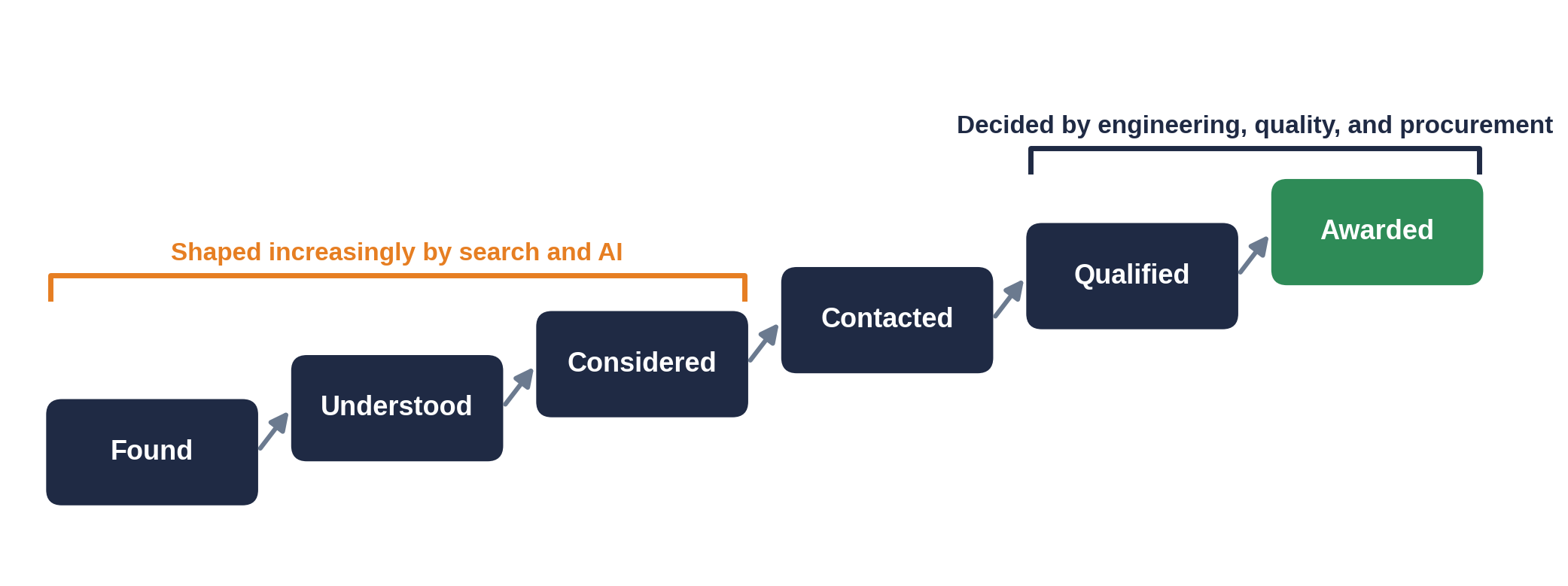
Being found does not get you on the approved vendor list. Engineering, quality, and procurement still do that, through drawings reviews, quality audits, first-article inspection, cybersecurity and export-control requirements, and contracts that need accountable signatures. No AI tool can audit your quality system or sign a supply agreement.
What AI and search do control is the step before all of that. Before a supplier is qualified, it has to be considered. As I wrote in The Factory Is Faster. Where Are the Customers?: “The approved vendor list determines who gets the orders. The consideration set determines who gets the chance to earn a place on the list.” Manufacturers have two jobs, and they’re separate: get into the consideration set, then win on the evidence the qualification gates require.
What do buyers need to see before they contact a manufacturer?
Buyers need specific, verifiable facts that let them decide quickly whether you’re worth a drawing. Those facts cover identity (who you are and where), capability (the processes, materials, sizes, and tolerances you hold routinely), credentials (certifications with their scope and registrar), fit (the industries you serve, the lot sizes and lead times where you perform best, and the work you don’t pursue), and engagement (how to request a quote and what information you need).
The strongest of those facts are demonstrated, not claimed. A five-axis machining center on your equipment list says you could make complex parts. A description of the materials, tolerances, and quantities you’ve actually held in production says you have. In my words from the book: “An equipment list is a claim. A part history is evidence.”
| Brochure website | Buyer-ready capability information |
|---|---|
| Lists machines by brand and model | Describes parts, materials, and tolerances held in production |
| “Quality is our top priority” | Certifications with scope, registrar, and status |
| Serves “demanding industries” | Names the industries and applications you know |
| Says yes to everything | States the work you seek and the work you don’t |
| Key details buried in PDFs | Key facts in readable text on the page |
| Different descriptions across directories | One approved description used everywhere |
What should a manufacturer do first to be found by the right buyers?
A manufacturer should start by seeing itself the way a buyer does. Write down a dozen questions a buyer who fits your best customer profile would actually ask, put them to several AI assistants, search engines, and industrial directories, and record what comes back about your shop, or whether it shows up at all. Then ask your last ten new customers how they found you. Those two exercises will tell you more about your discovery problem than any marketing report.
To organize what your leadership team already knows, take the Manufacturing Growth Opportunity Assessment at AIManufacturingGrowth.com/assessment. Its market development domain helps you frame how the company develops suitable buyers beyond its established customers, and whether a prospective buyer can readily understand what you do well.
Your next step
Visibility is the cheapest stage to measure and the least valuable to win on its own. Every month your public description stays generic, the buyers who need exactly what you do are building short lists without you, and the gap won’t show up on any report you currently run. Find out where your business stands in a few minutes at AIManufacturingGrowth.com/assessment.
Disclaimer
The Manufacturing Growth Opportunity Assessment is an educational investigation guide. It organizes what you report about your business into areas to review and information to gather. It does not diagnose your business, identify your system constraint, value any opportunity, or forecast results, and it is not legal, financial, or compliance advice.
FAQ
How do industrial buyers find new suppliers today?
Mainly through internet search (64%) and referrals (63%), followed by trade publications (31%), according to Paperless Parts’ 2022 survey of more than 600 U.S. part buyers and engineers. AI-driven sourcing is growing, especially in aerospace and defense.
Are referrals still important for manufacturers?
Yes. Referrals ran nearly even with search in the 2022 survey, and Paperless Parts reported that buyers’ reliance on referrals rose 17% over the prior two years.
Will AI assistants recommend my shop to buyers?
No one can guarantee that. Specific, consistent, verifiable information improves the odds that AI tools describe you correctly, and AI never replaces a buyer’s own supplier qualification.
Does being found get me on an approved vendor list?
No. Engineering, quality, and procurement still qualify suppliers through audits, first articles, and contracts. Being found gets you the chance to be considered.
What’s the fastest way to see how buyers see my shop?
Ask AI assistants and directories the questions your ideal buyer would ask, and record what they say about you. Then ask your newest customers how they found you.
Does the assessment check my website or my AI visibility?
No. It records your leadership team’s view of how you develop new buyers and whether your capability information is clear, and suggests what to review.
References
Paperless Parts. (2022, December 19). Industrial Buyer Survey Reveals New Implications for U.S. Manufacturers Throughout the Supply Chain. https://www.paperlessparts.com/press/industrial-buyer-survey-reveals-new-implications-for-us-manufacturers-throughout-the-supply-chain/
Paperless Parts. (2020). 2020 Part Buyer Expectations Report. https://www.paperlessparts.com/wp-content/uploads/paperless-parts-buyer-survey-report-2020.pdf
Xometry. (2026, February 3). Aerospace & Defense Leaders Prioritize AI-Enabled Sourcing to Strengthen Domestic Supply Chains. https://investors.xometry.com/news-releases/news-release-details/aerospace-defense-leaders-prioritize-ai-enabled-sourcing
Witt, C. (2026). The Factory Is Faster. Where Are the Customers?
← All Manufacturing Growth Insights