

The Factory Is Faster Series · 06
Has My Constraint Really Moved to Sales? Why You Should Prove It Before You Pay to Fix It
Fixed the factory and now told your constraint is sales? Learn how to prove it first, and take the free Manufacturing Growth Opportunity Assessment.

“The location of the constraint is the first fact a leadership team must establish and the last fact it should assume.”
— Curtiss Witt
Your constraint may have moved to sales, and after a serious improvement effort it often has, but that has to be proven, not assumed. “Fix the factory and the constraint moves to sales” sounds airtight and fails in five predictable ways: improvement freed capacity in the wrong place, the freed capacity doesn’t match the work buyers send, a policy is eating the capacity, the real limit is your estimating team, or buyers still remember the slow factory you used to be. Even when the limit truly is in the market, it takes one of three different forms, and each needs a different fix. Prove where the constraint is before anyone spends money on the cure.
What does it mean for a constraint to move?
A constraint moves when the factor that limits the whole business’s performance changes location. A constraint is whatever limits a system relative to its goal, and for a business the goal is to make money now and in the future. Eliyahu Goldratt compared it to a chain: the chain is only as strong as its weakest link, and strengthening any other link does nothing.
That makes a constraint different from a bottleneck. A bottleneck is any resource whose capacity is equal to or less than the demand placed on it. A plant with more capacity than suitable orders can still have a machine with a queue in front of it on a given day, while the real limit on the business sits somewhere else entirely. As I wrote in The Factory Is Faster. Where Are the Customers?: “The location of the constraint is the first fact a leadership team must establish and the last fact it should assume.”
Why do improvement programs make leaders believe the constraint moved to sales?
Improvement programs make the belief feel obvious: the plant was the constraint, the plant got better, so the limit must now be the supply of orders. Each step in that reasoning has a gap.
- Location. Programs often free capacity where improvement was easiest, which isn’t always where the constraint was.
- Mix. The freed capacity sits on particular resources. If the work buyers send routes through a resource that is still loaded, you are short of capacity for the orders you get and long on capacity for orders you never see.
- Policy. Release rules, priorities that change daily, and measures that reward keeping every machine busy can eat capacity the plant appears to have.
- The front office. A two-person estimating team with a growing queue is an internal constraint wearing a sales costume.
- Feedback. A plant that was late for two years taught customers to send urgent work elsewhere. Demand returns slowly, even after the plant improves.
The national numbers won’t settle the question for you. The Federal Reserve reported U.S. manufacturing capacity utilization at 75.7% in August 2026, but a national index can’t tell you which resource limits your business. And the estimating constraint is easy to miss: Paperless Parts’ 2020 buyer survey found that 67% of part buyers expect a quote in less than 24 hours, so a slow quote desk can lose work no matter how fast the floor runs. These are operational problems wearing commercial clothes, and they yield to operational discipline.
What kinds of market constraints are there?
A market constraint comes in three forms, and calling all three “a sales problem” guarantees the wrong cure for at least two of them. A demand ceiling means total suitable demand for what you do is smaller than your capacity; the fix is new markets, new capabilities, or a strategic decision about size. A discovery constraint means suitable buyers exist but can’t find you, or can’t tell from what they find that you fit; the fix is clearer capability information and better market development. A conversion constraint means suitable buyers find you and send work, but too little becomes orders; the fix is better qualification, faster quoting, and learning from lost bids.
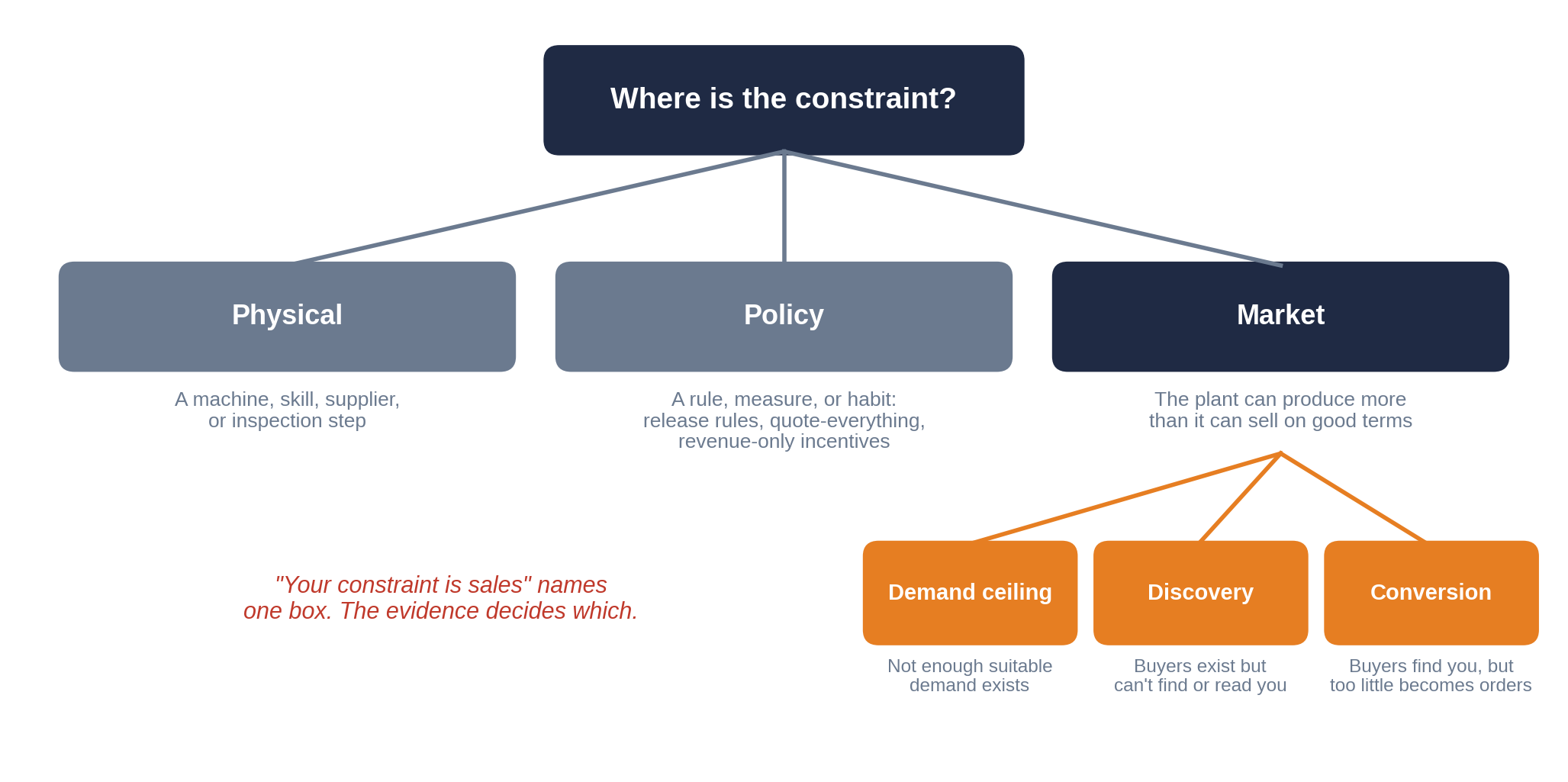
The forms also interact. A discovery constraint can look exactly like a demand ceiling: leaders conclude the market is saturated when the market simply can’t see them.
How do you prove where your constraint is?
You prove where your constraint is by following the evidence in a deliberate order, and it takes a few weeks of leadership attention, not new software.
- Follow the queues. Work waits in front of the constraint. Walk the floor, then confirm it in the system.
- Trace the late orders. A physical constraint leaves a pattern. Lateness scattered everywhere usually points to policy.
- Compare load with capacity by resource, counting people, programming, and inspection, not just machine hours.
- Examine the front end. A long estimating queue is an internal constraint. Few, poorly matched inquiries point to discovery. Good-fit inquiries that rarely convert point to conversion.
- Read your policies. For each rule and measure, ask what behavior it produces and whether that behavior serves throughput.
- Ask the people closest to the work. People closest to the work usually know where the constraint is long before the dashboard does.
To organize what your leadership team already knows before you start, take the Manufacturing Growth Opportunity Assessment at AIManufacturingGrowth.com/assessment. Its capacity and constraints domain helps you frame how clearly your team sees where work could fit, and what evidence to gather next.
| Assume the constraint moved to sales | Prove where the constraint is |
|---|---|
| Hire a salesperson or sign a marketing retainer | Trace queues, late orders, and the quote log first |
| Treat idle machines as sellable capacity | Count people, programming, inspection, and routings |
| Blame marketing when estimators fall behind | Recognize the estimating queue as an internal constraint |
| Treat every market problem the same way | Separate demand ceiling, discovery, and conversion |
| Decide once | Re-check whenever demand, mix, or staffing changes |
What if the constraint really is in the market?
If the evidence shows the constraint really is in the market, you’ve found the most valuable place for it to be. Many experienced Theory of Constraints practitioners argue that the healthiest arrangement is a factory with enough protective capacity to deliver reliably, with the market as the limit, because then growth becomes a commercial question you can manage deliberately. That’s when a disciplined commercial system pays: one that knows which work fits your open capacity, which buyers send it, and whether they can find you.
Choosing the location of the constraint is one of the most consequential strategic decisions a manufacturing executive can make. Most never make it on purpose. They inherit whatever the last round of improvements produced.
Your next step
If you’re about to hire, sign a retainer, or launch a campaign because someone told you your constraint is sales, a few weeks of investigation is the cheapest insurance you’ll ever buy. A few minutes with the Manufacturing Growth Opportunity Assessment shows your leadership team what it can already prove and what it can’t. Start at AIManufacturingGrowth.com/assessment.
Disclaimer
The Manufacturing Growth Opportunity Assessment is an educational investigation guide. It organizes what you report about your business into areas to review and information to gather. It does not diagnose your business, identify your system constraint, value any opportunity, or forecast results, and it is not legal, financial, or compliance advice.
FAQ
Has my constraint really moved to sales?
Possibly, but it has to be shown. Improvement can free capacity in the wrong place, leave a mix mismatch, or expose an estimating or policy constraint that looks like a sales problem.
What’s the difference between a bottleneck and a constraint?
A bottleneck is any resource with as much or more demand than capacity. A constraint is whatever limits the whole business against its goal. They aren’t always the same thing.
What are the three kinds of market constraint?
A demand ceiling (not enough suitable demand), a discovery constraint (buyers can’t find or understand you), and a conversion constraint (buyers find you, but too little becomes orders).
Can my estimating team be the constraint?
Yes. When quote volume rises and turnaround stretches, good opportunities wait behind poor ones and buyers go elsewhere. Paperless Parts found 67% of part buyers expect a quote within 24 hours.
Will the assessment tell me where my constraint is?
No. It never names your system constraint. It organizes what your team reports about capacity and delivery pressure, and points to the evidence that would answer the question.
How often should we re-check where the constraint is?
At least quarterly, and immediately when demand, product mix, staffing, or equipment changes.
References
Goldratt, E. M. (1990). What Is This Thing Called Theory of Constraints and How Should It Be Implemented? North River Press.
Goldratt, E. M., & Cox, J. (1984). The Goal: A Process of Ongoing Improvement. North River Press.
Federal Reserve Board. (2026, September 18). G.17 Industrial Production and Capacity Utilization, Table 12: Manufacturing. https://www.federalreserve.gov/releases/g17/20260918/table12.htm
Paperless Parts. (2020). 2020 Part Buyer Expectations Report. https://www.paperlessparts.com/wp-content/uploads/paperless-parts-buyer-survey-report-2020.pdf
Witt, C. (2026). The Factory Is Faster. Where Are the Customers?
← All Manufacturing Growth Insights