
The Factory Is Faster Series · 04
What Is a Good RFQ Win Rate for a Job Shop? Why the Number Means Nothing Without Its Reasons
Job shops win about 30% of quotes on average. Learn what a good RFQ win rate really looks like and take the free Manufacturing Growth Opportunity Assessment.
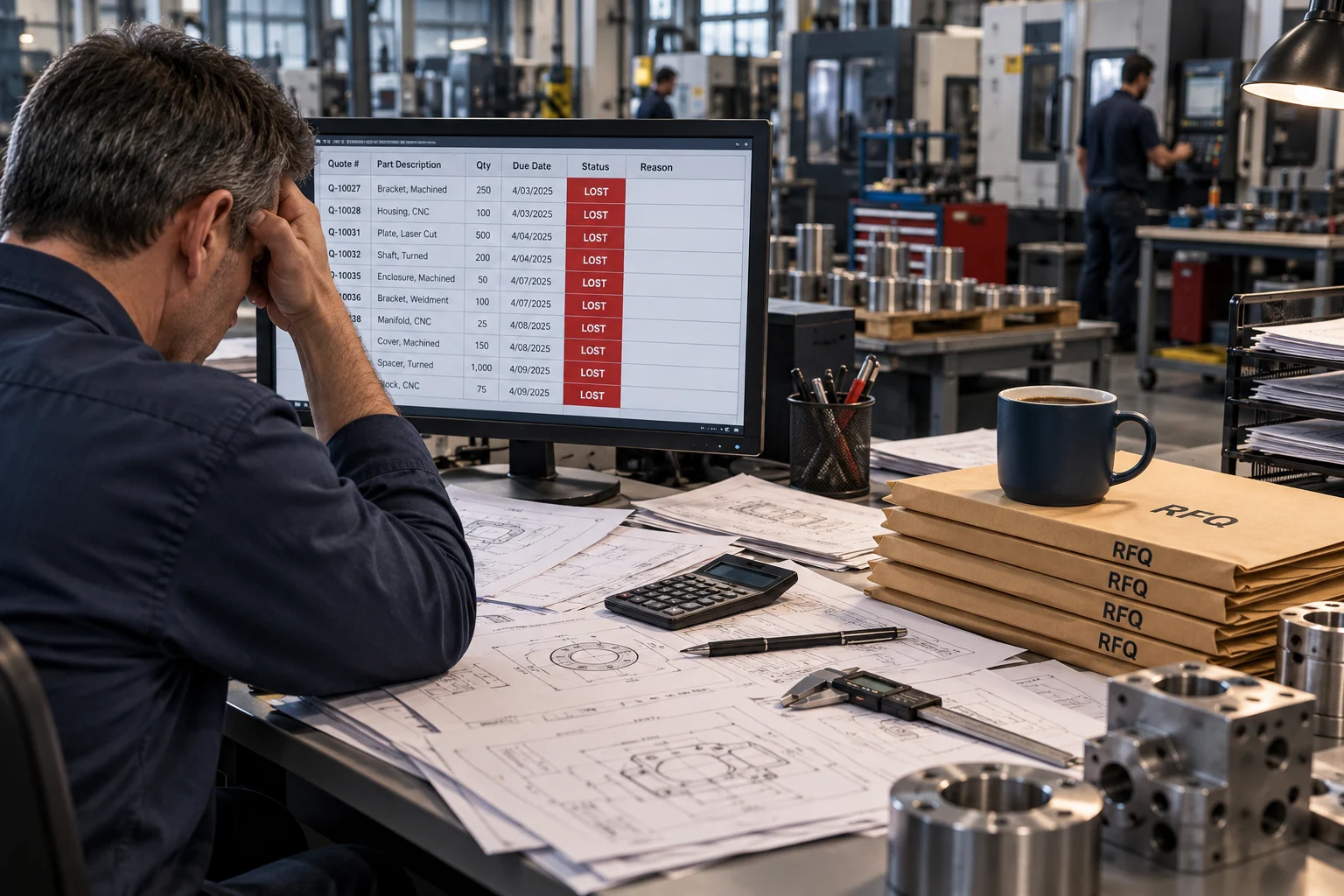
“A lost quote without a recorded reason is a lesson the company paid for and refused to take.”
— Curtiss Witt
Paperless Parts, the quoting-software company, reports that job shops win about 30% of the jobs they quote, and that most shops win between 20% and 30%. That’s the industry’s rough average. A good win rate, though, isn’t a single number. It’s a win rate that rises on the work your plant runs best, from the buyers you most want, while you stop spending senior estimating time on work you were never going to win. The overall percentage, without what was won and why the rest was lost, tells you almost nothing.
What RFQ win rate do job shops actually get?
Job shops typically win 20% to 30% of what they quote, according to Paperless Parts, which means seven of every ten quotes produce no revenue. Speed is part of the reason. Paperless Parts’ 2020 Part Buyer Expectations Report, a survey of more than 400 U.S. part buyers and engineers, found that 67% of buyers expect a quote in less than 24 hours, up from 53% the year before, and only 6% are willing to wait longer than three days. The company also reports that 75% of buyers make a decision within a week of receiving a quote.
Those numbers explain a lot about lost work. A quote that arrives on day four may be accurate, well priced, and irrelevant, because the buyer has already moved on. Speed at the quote desk now matters as much as speed on the shop floor.
But averages from other shops won’t tell you whether your own number is good. A prototype shop chasing fast-turn work and a production machining house bidding into formal OEM sourcing events live in different worlds. The useful benchmark is your own performance over time, broken down by the kind of work and the kind of buyer.
Why can a high win rate be a warning sign?
A high win rate can be a warning sign because it may mean you’re underpricing, quoting only the easiest work, or relying on one customer who awards almost everything. A shop that wins most of what it quotes may be leaving money on the table on every order, or quietly filling its constraint with work that looks good on a sales report and bad on a schedule. A low win rate may reflect smart, selective bidding in competitive segments where the wins that do come are highly valuable.
That’s why a high win rate deserves as much scrutiny as a low one. The win rate means little until it is read alongside what was won and what that work did to the system: the throughput it generated, the constraint time it consumed, and whether existing customers still got their parts on time.
What does quoting really cost a manufacturer?
Quoting costs the time of exactly the people a manufacturer can least afford to lose: senior estimators, manufacturing engineers, programmers, and often the owner. A serious quote means reading the drawing, planning a routing, estimating setups and cycle times, pricing material and outside processes, and judging the risk in tolerances and quantities. Those are the same people who solve production problems and support your best customers.
Quoting is production. It has a constraint, a queue, a yield, and a cost. When marketing succeeds in bringing in more requests, the estimating team often becomes the bottleneck: turnaround stretches, good opportunities wait in line behind poor ones, and buyers who needed a fast answer go elsewhere. Treat estimating capacity as a resource to be managed against the constraint, like any other.
How should a job shop decide which RFQs to quote?
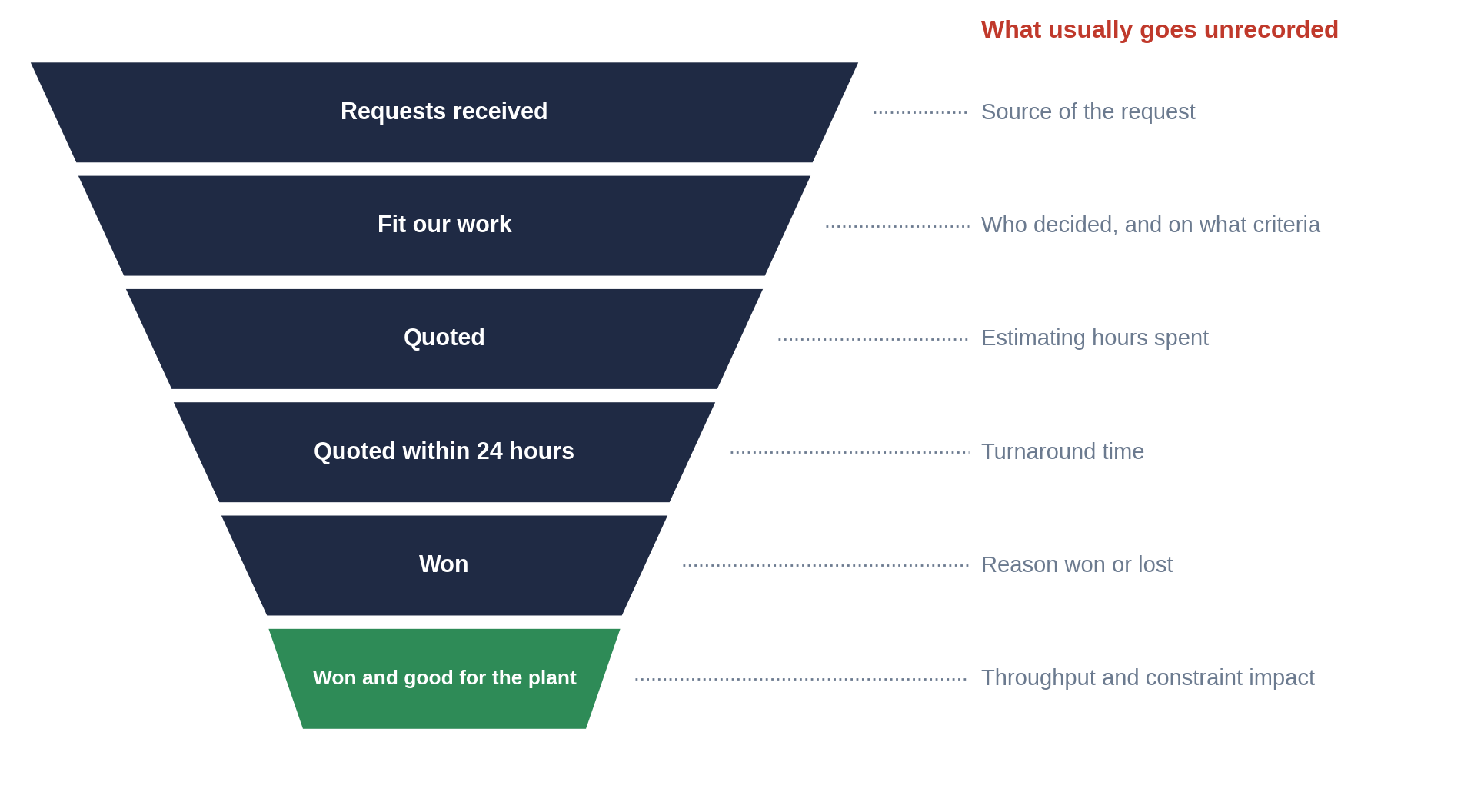
A job shop should decide which RFQs to quote by testing each significant request for fit before committing estimating time. Four tests cover most of it. Technical fit: can you make the part reliably with capabilities you’ve demonstrated? Delivery fit: can the routing be absorbed without endangering existing commitments? Commercial fit: are the price, terms, flowdowns, and documentation sustainable? System fit: what will the order do to your constraint and your throughput? A quote can win while failing any of those tests.
The decision doesn’t have to be yes or no. Some requests deserve a bid. Some deserve questions first, because a tolerance or quantity may not be what it seems. Some fit, but not now. And some deserve a fast, respectful decline, ideally with a referral to a shop that does that work well.
| Quote everything that arrives | Qualify before quoting |
|---|---|
| Every request gets the same effort | Effort matches fit and opportunity |
| Estimators decide alone, or nobody decides | Sales, estimating, and operations share written criteria |
| Good opportunities wait behind poor ones | Fitting requests move to the front of the queue |
| Win rate is the only measure | Win rate is read with fit, reasons, and system effect |
| Lost quotes fade from memory | Every significant quote leaves a reason behind |
How do you learn from quotes you lose?
You learn from lost quotes by recording an outcome and the best available reason for every significant quote, then reviewing the pattern on a fixed schedule. Industrial quotes end in at least six ways: won, lost on price, lost on lead time, lost on capability or terms, no decision or cancelled project, and withdrawn by you. Each tells you something different. A run of lead-time losses points to scheduling or capacity. Price losses in one segment and wins in another show where your costs are competitive.
As I wrote in The Factory Is Faster. Where Are the Customers?: “A lost quote without a recorded reason is a lesson the company paid for and refused to take.” Review the quote log quarterly with sales, estimating, operations, and leadership in the same room.
If you want a structured place to start, take the Manufacturing Growth Opportunity Assessment at AIManufacturingGrowth.com/assessment. Its RFQ effectiveness domain helps your team frame how well incoming requests fit, how outcomes and reasons are tracked, and how the decision to quote gets made, then names the evidence to gather.
Your next step
Every week your estimators quote work your plant should never run, the buyers you actually want wait longer for an answer, and two-thirds of them expect one within a day. A few minutes with the Manufacturing Growth Opportunity Assessment will show your leadership team where your RFQ process stands and what to examine first. Start at AIManufacturingGrowth.com/assessment.
Disclaimer
The Manufacturing Growth Opportunity Assessment is an educational investigation guide. It organizes what you report about your business into areas to review and information to gather. It does not diagnose your business, identify your system constraint, value any opportunity, or forecast results, and it is not legal, financial, or compliance advice.
FAQ
What is a good RFQ win rate for a job shop?
Paperless Parts reports an average of about 30%, with most shops between 20% and 30%. A good win rate is one that rises on the work your plant runs best, measured against your own history by type of work and buyer.
How fast should a job shop return a quote?
Paperless Parts’ 2020 buyer survey found 67% of part buyers expect a quote in less than 24 hours, and only 6% will wait longer than three days.
Is a high win rate always good?
No. It can signal underpricing, quoting only easy work, or dependence on one customer. Read it alongside what you won and what that work did to your plant.
Should we quote every RFQ we receive?
No. Quoting consumes your most experienced people. Qualify significant requests for technical, delivery, commercial, and system fit before spending estimating time.
Will the assessment tell me if my win rate is too low?
No. It never compares your win rate with industry figures or sets a bid threshold. It helps you see whether you track outcomes and reasons, and what evidence to gather next.
What should a quote log track?
For every significant request: its source, fit, estimating hours, turnaround, outcome, and the best available reason, with how confident you are in that reason.
References
Paperless Parts. The 7 Fatal Mistakes of Quoting, #1: Treating Every Quote the Same. https://www.paperlessparts.com/blog/the-7-fatal-mistakes-of-quoting-1-treating-every-quote-the-same/
Paperless Parts. Costing Is a Science, Pricing Is an Art: The Over-Engineered Quote (webinar). https://paperlessparts.com/resources/webinar-costing-is-a-science-pricing-is-an-art-the-over-engineered-quote
Paperless Parts. How to Increase Your Win Rate When Quoting Machining Jobs (webinar). https://www.paperlessparts.com/resources/webinar-how-to-increase-your-win-rate-when-quoting-machining-jobs/
Paperless Parts. (2020). 2020 Part Buyer Expectations Report. https://www.paperlessparts.com/wp-content/uploads/paperless-parts-buyer-survey-report-2020.pdf
Witt, C. (2026). The Factory Is Faster. Where Are the Customers?
← All Manufacturing Growth Insights